La Scala’s New Overture: Cultivating the Next Opera Greats, From Milan to the Manhattan
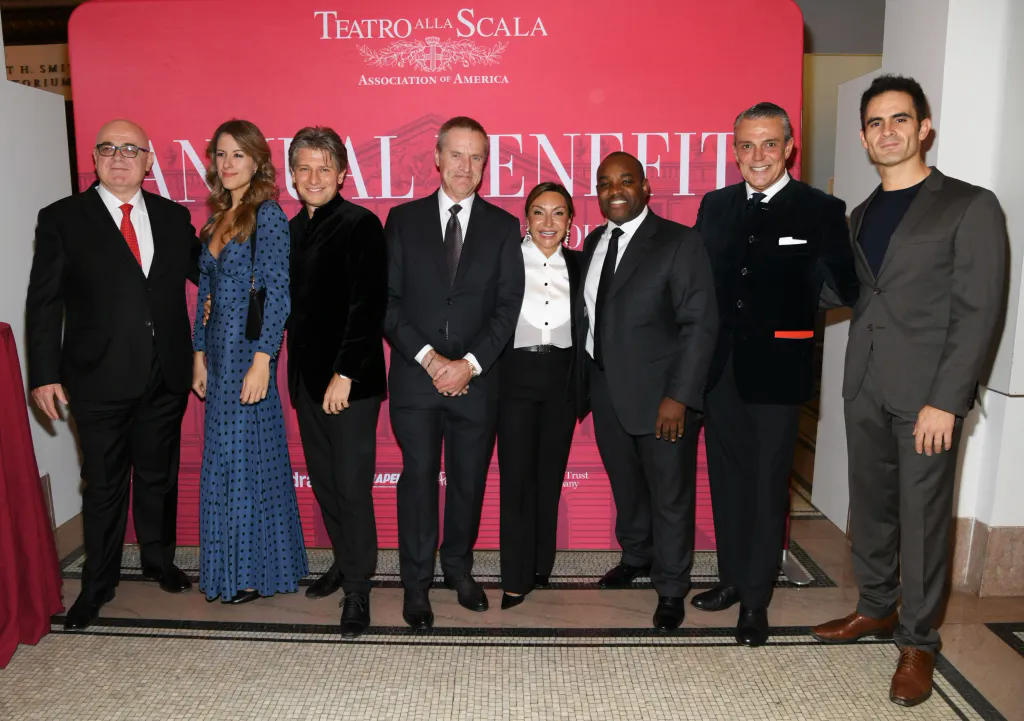
Fortunato Ortombina, Francesca Dego, Daniele Rustioni, Kirill Sheynkman, Milena Adamian, Larry Brownlee, Paolo Gavazzeni, and Giacomo Sagripanti at the Teatro alla Scala Association of America Annual Benefit at The New York Historical.
Article by Lee Fryd from New York Social Diary
Italy, the birthplace of opera. La Scala, its iconic home. Within its gilded red and gold walls, opera, ballet, and symphony. Its neoclassic structure an ode to art and architecture. Acoustics so perfect, no microphones allowed.
“It is, quite simply, the perfect opera house,” Milena Adamian, President of Teatro Alla Scala Association of America, told me. “Walk in and you feel like you’ve been hugged. You are surrounded by this beauty, but not in your face. It’s like the warm feeling you get when you come home from the outdoors. Yet, the building looks unremarkable from the street. Tourists pass by and wonder, is this it? That is Milanese elegance: magnificent courtyards and houses hidden from the street.”
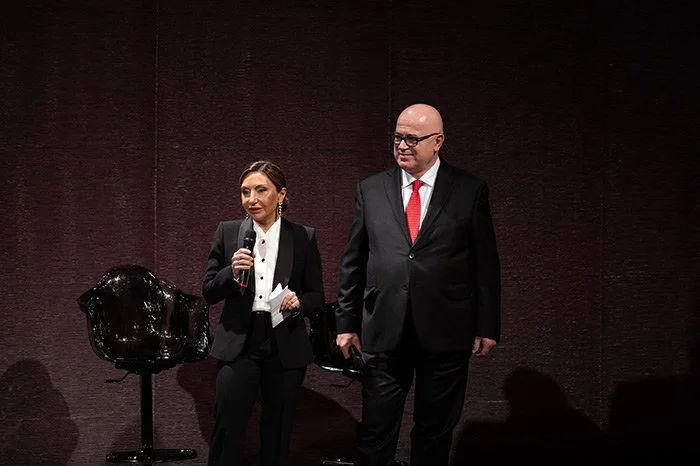
Milena Adamian and Fortunato Ortombina pay tribute to Giorgio Armani. Adamian even wore an Armani tux for the occasion.
“When the doors open, that is Scala! But, first, walk through two gates, a vestibule, a beautiful foyer with mirrors and statues. Then, into the auditorium. That is the killer. You stop breathing because of the beauty. And, of course, there is the performance.”
Adamian and her husband — who divide their time between New York and Milan — have always given to La Scala. But as they began spending more time in Milan, she reached out to do more. Thus began the Teatro alla Scala Association of America. Their first member: Giorgio Armani. He was remembered at the 2025 Teatro alla Scala Association of America Annual Benefit gala.
He loved La Scala. CEO and Artistic Director of Teatro alla Scala Fortunato Ortombina told the room. “The story of Giorgio is another story of talent attracted by Milan.”
As was Callas. The grandson of one of her favorite La Scala conductors, Gianandrea Gavazzeni, is now its Artistic Coordinator, Paolo Gavazzeni. He moderated a masterclass between Maestro Daniele Rustioni — Principal Guest Conductor at the Met for the next three years (only the third person in the Met’s history) — and the soprano, Juliana Grigoryan, he will direct there for “La Bohème.”
“We always make our gala a performance centric event,” Adamian told me, “to demonstrate the mastery of La Scala in a big way.” And so they did.
They brought the traditional behind-the-scenes first meeting between maestro and diva to us on stage. Grigoryan sang “Sì, mi chiamano Mimì.” Exquisite. Then, Rustioni began directing: explaining, phrasing with his arms, his body, even singing beautifully himself. At one point, Gavazzeni jumped in, saying, “Remember, she is flirting when she says ‘I Live Alone.’”
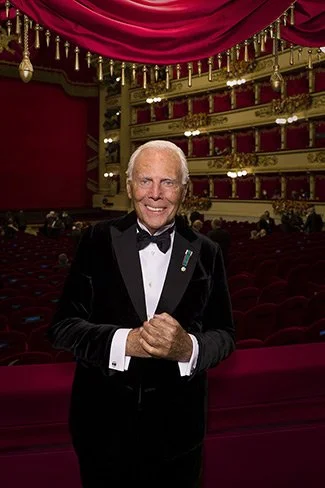
Teatro alla Scala will dedicate the opening night of its 2025/2026 Ballet Season to Giorgio Armani. The evening, featuring Tchaikovsky’s The Sleeping Beauty in Rudolf Nureyev’s choreography, will take place on December 18, 2025.
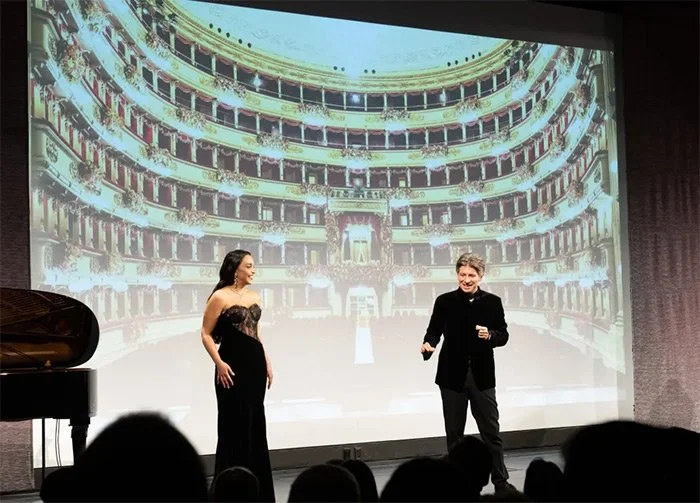
Juliana Grigoryan and Daniele Rustioni.
Tonight, I had this incredible opportunity to show what I do behind the curtain,” Rustioni told me later, “finding artistic agreement, making music together. When, I get up to the podium, I am like a fulcrum. Of course my job is to get everything together. But, most importantly, I must be convinced all the positions in front of me on stage are following the same interpretation. That’s the most difficult. Tonight, we spoke about how much the gesture — moving the arms and the baton with clarity — is important. But, it doesn’t come from there.”
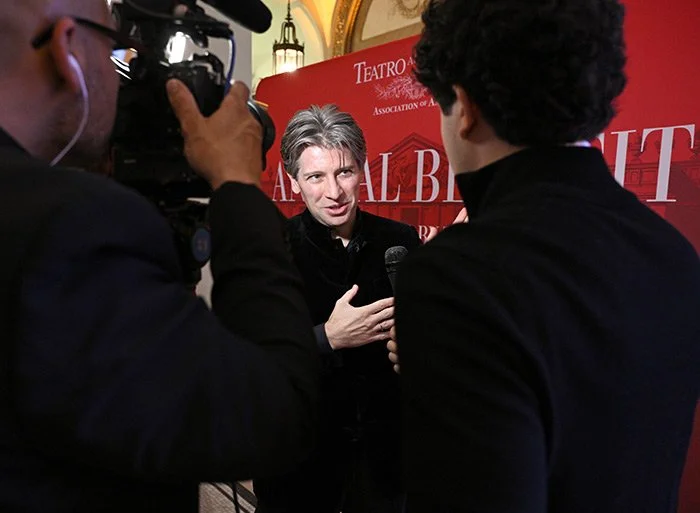
Rustioni continued, “The most important thing is to have a truth inside yourself and a strong will to communicate. To digest the music, the score, to be in the mind and shoes of the composer to re-create in theory here what they envisioned.”
Gavazzeni and Rustioni are literally children of Scala
“I feel like I am a son of La Scala because I started my career in its children’s choir,” Rustioni said. “That changed my life.” He was, in a way, anointed at age nine by Riccardo Muti. Singling Daniele out for his precision, Muti declared, “One day you will be a conductor.”
But, what does a conductor even do, Gavazzeni, who told that story, wondered as a seven-year-old watching from La Scala’s wings. “I started studying the piano at six,” he recounted, “always one hour or two hours a day insulting myself for my mistakes. So, I say OK let’s go to see what my grandfather is doing. I stood by the stage of a dress rehearsal for Verdi’s Don Carlo.
“I thought: the orchestra were playing the chords in front of them. The choir knew by heart their role. The singers were amazing. I was a very civilized kid, but always questioning …. I went to my grandfather and asked, ‘What are you doing? You don’t play any instrument. You don’t sing. You are just shaking your hands. I saw on stage the greatest tenor, the greatest soprano. Why are you there?’”

Bryan Wagorn, Juliana Grigoryan, Daniele Rustioni, and Paolo Gavazzeni backstage.
He learned. And illustrated a greater lesson: exposure to opera at an early age can lead to a lifetime passion.
Thus, the association’s goal is to foster new generations on both sides of the stage. The evening’s title: “For the Young by the Young.”
To nurture stars of tomorrow, they support an annual production by the students and graduates of the Academia Teatro all Scala during the fall season. To create future opera aficionados, they …
Photography by Gary Gershoff for Larry Busacca Photography