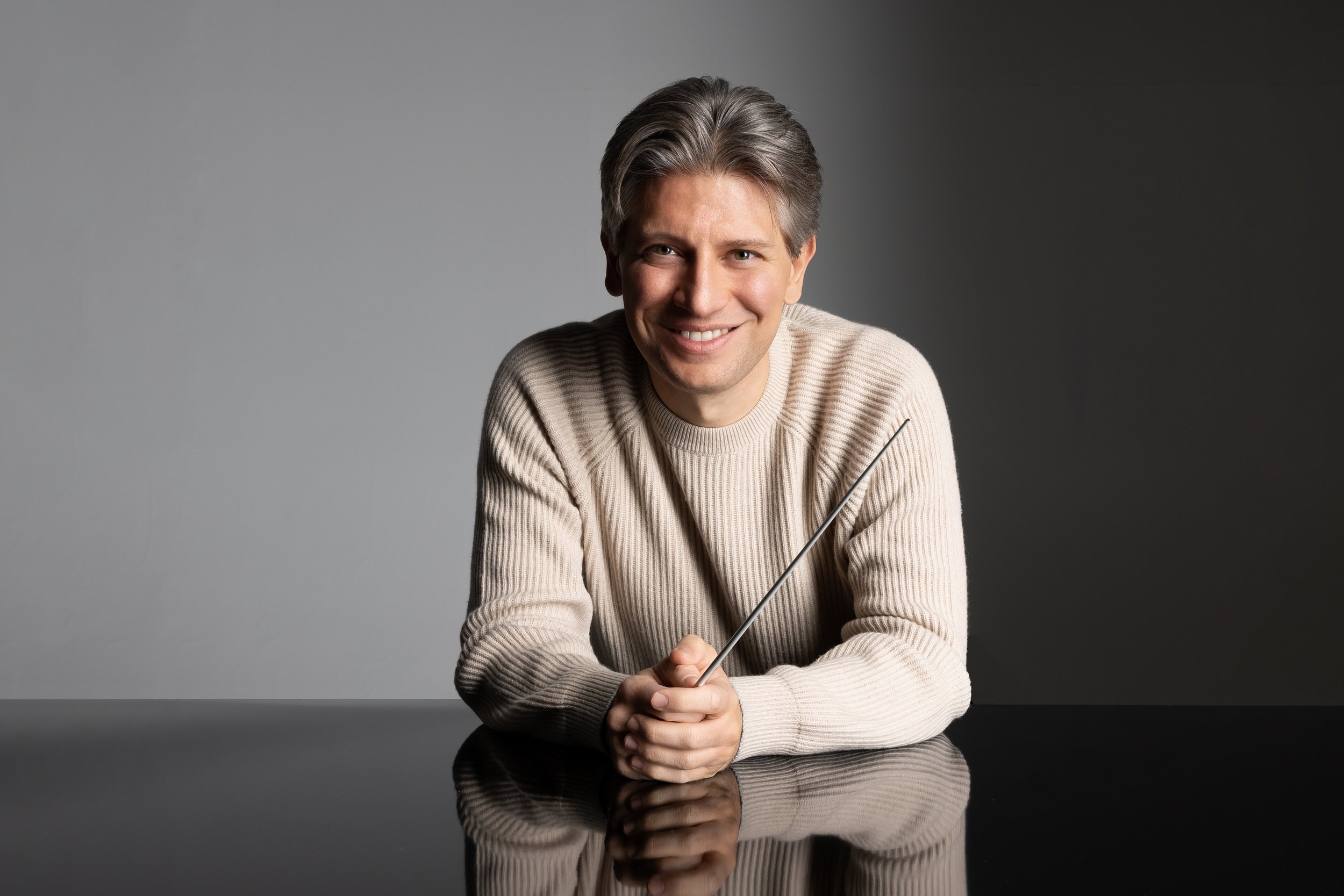
Article by Steve Holt from SF Symphony
Music as an Act of Love
Debuting conductor Daniele Rustioni on the magic of music
At age 42, Italian conductor Daniele Rustioni already has an impressive conducting resume in both opera houses and symphony halls. He currently serves as principal guest conductor of the Metropolitan Opera, only the third in its 143-year history, and he just concluded an eight-year term as music director of Opéra National de Lyon.
But his CV is also studded with major symphonic appointments and appearances around the globe, including 10 years with Orchestra della Toscana in Florence, and five years with the Ulster Orchestra in Belfast as music director. His guest conducting appearances are a virtual encyclopedia of the world’s greatest orchestras, from London to New York, from Philadelphia to Pittsburgh, from Cleveland to Tokyo, and of course these concerts, his debut with the San Francisco Symphony.
So: is he an opera conductor or a symphony conductor?
“It’s an interesting question, given my background, but I think the answer is ‘both,’” Rustioni says. “Look at the history of conductors like Herbert von Karajan and Carlos Kleiber. They started as Kapellmeisters [chief conductors in a German opera house], and then in their middle 40s, they shifted gradually to a more symphonic repertoire, but only after they had something like 50 operatic titles under their belt. I like to think that I’m trying to reproduce one of these historical journeys as a conductor. In the Italian tradition, if we think about Toscanini, Giulini, Abbado, and Muti, they all were, or are, exquisite symphony conductors, and they touched a lot of non-Italian operatic repertoire as well. So that's the goal for me.”
Rustioni knew he wanted to be a musician after appearing as one of the Three Boys in The Magic Flute at La Scala at age 13, but it wasn’t until his early 20s that he decided that conducting would be his path. “Certainly, I was building up to that, from playing chamber music as a pianist, to having a lot of experience on the music staff at a theater,” he says. “Without those experiences, it’s impossible to understand what conducting is. You have to dig in and start to understand the anticipation of the sound, and the relationship between your gestures and the natural decay of the sound, and, most importantly, what the orchestra needs from you.”
Rustioni also points to early posts at Mikhailovsky Opera and Ballet Theatre in St. Petersburg and Covent Garden in London as fundamental in his development. “It was a great opportunity to absorb everything I could. It was theory and practice together, and that’s the best combination. Having constant contact with the same group of musicians in St. Petersburg, I learned a lot: how to balance how much I give and I offer, and how much I should just listen to what the orchestra is giving me.”
This wisdom has carried over into his work as a guest conductor. “You need to be able to have the two channels open in equal parts, especially when you are more advanced in your career, and you’re lucky enough to conduct some of the best ensembles on the planet. You don’t just want to impose your will; you need to work with their knowledge as well.”
One reality of guest conducting is constant travel, and very little rehearsal time. But for Rustioni, managing those restrictions means more than just studying scores while jetting around the globe.
“You need to be a complete artist or human being,” he says. “You need to live your life as fully as possible. So at a certain point it becomes limiting just to focus on the scores. You need to read, you need to know what’s happening in society, because ultimately, an orchestra is the mirror of society. Ultimately, we make music for the audience. It’s a social art.”
Rustioni speaks eloquently about the alchemy between conductor, composer, musicians, and audience. “Music evokes more than it describes. This evocative power is very abstract and ethereal, and that’s the magic. It’s a fascinating profession, and everyone says the same thing at the end of their career: ‘It’s such a pity to stop now; I was just starting to understand what means to be a conductor!’”
Rustioni has many heroes and mentors, from Muti to Daniel Barenboim. He’s reluctant to list them all for fear of leaving anyone out, but he’s never forgotten these words of wisdom from Carlo Maria Giulini.
“I was very young, watching him rehearse in Milan, and one day he said to me, ‘Daniele, la musica è un atto d’amore.’ Music is an act of love, in the most metaphysical and spiritual way. As a conductor, I take that to mean we need to be serious and noble and respectful. Of course, every one of us is different, with a different aura, charisma, authority, and energy on the podium, but the foundation should be that respect. Giulini was really a servant of the music. Maybe to say that nowadays is boring, but I don’t care. [laughs]. In our modern world, where we’re inundated with social media and the like, I think it’s good to have a strong vision of these ancient ideas of music.”
Steve Holt is an arts reporter and Contributing Writer to the San Francisco Symphony program book.
Daniele Rustioni conducts Dvořák’s Cello Concerto, with Daniel Müller-Schott as soloist, and Brahms’s Symphony No. 2, March 13 and 15.