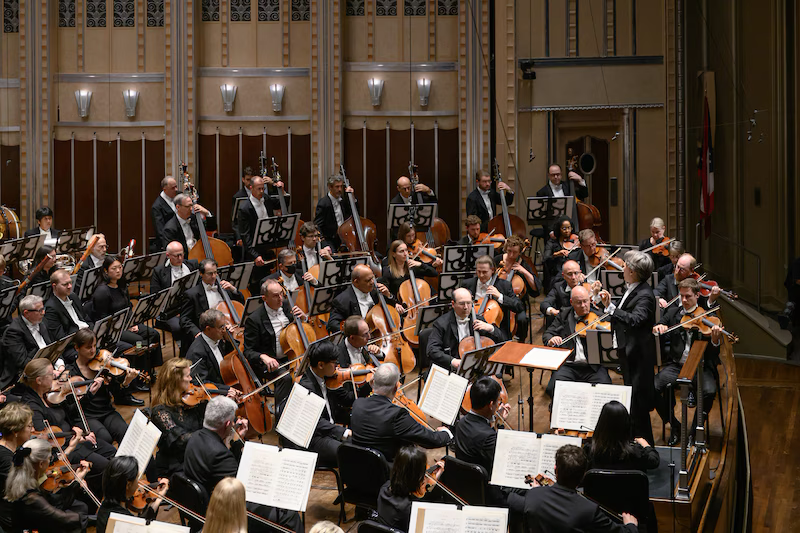
Photocredit: Human Artist Photography + Cinema
Paul Jacobs, Daniele Rustioni and the Cleveland Orchestra
(April 2026)
by Mark S Jordan
“…Italia, Alfredo Casella’s symphony-sized fantasy based on folk and popular music from his home country, was performed in Cleveland in 1923 with the composer conducting. I doubt if it has been heard here since, but it proved to be a delight. The movements range from highly dramatic (even melodramatic) to plaintively reflective (including a long, expressive English horn solo delivered with both elegance and ache by Robert Walters, who is surely having the season of his career this year), to over-the-top romping. The latter came in a finale that made use of ‘Funiculì, Funiculà’, the Luigi Denza song we last heard here in 2018 when Cleveland Orchestra music director Franz Welser-Möst conducted Richard Strauss’s early tone poem, Aus Italien. Strauss used the tune without permission, thinking it was a folk song, and he ended up having to pay a hefty sum to Denza for copyright violation. Casella knew better, and got Denza’s permission.
Almost as if to mock Strauss, Casella turned his version of the tune into an orgiastic riot of orchestral color which, frankly, leaves Strauss in the dust. Rustioni tore into this rarity like a man possessed, and the orchestra gave him a performance that rocked Severance Music Center to the rafters. Rustioni’s final cutoff was so vehement, he ended up halfway spun around, facing the audience, while the viola players retrieved his baton which had gone flying. No matter, it was a thrilling encounter with a piece that proves Italian composer Ottorino Respighi was part of a movement of nationalist composers intent on using every capacity of the modern orchestra in the early twentieth-century to dazzle and stun audiences. Deploying such resources on music based on slight tunes is a little like deploying a thermonuclear guided missile to kill a handful of mosquitos, but when it is this entertaining, why not?
I wondered if the rambunctious Casella piece would make Debussy’s La mer seascape seem anticlimactic, but I needn’t have worried. Rustioni wasn’t having any of the vague, ‘impressionist’ half-tints often imposed on the piece. Instead, he encouraged the orchestra to color boldly while he kept the tempo moving along, avoiding the longueurs that so often beset performances. The conductor kept a keen eye on the flow of phrases and knew where to ease the tempo at key transition points. The opening was resolute, building and ebbing in a single breath; the middle movement was daringly deft; and the finale was, for once, a thrilling battle of the elements. This was the sixth La mer I have heard live, and it was the best by far. As an extra detail, for those who keep track of such things, the performance included the interpolated brass calls near the end, despite their dubious authenticity, and I was glad of it. If Debussy didn’t write those, he should have: their inclusion helps build the stormy drama of the closing pages and once heard, the passage sounds too sparse without them.
The first half of the concert had been considerably more veiled in color and rightly so. Gabriel Fauré wrote a suite of incidental music for a production of Maurice Maeterlinck’s gloomy Pelléas et Mélisande. (And I can say that about Maeterlinck because I once acted in a college performance of one of his doleful pieces and became intimately familiar with the playwright’s cryptic, oppressive world.) It was so startlingly different from anything else written in this period that it bewitched many composers, including Debussy, Sibelius and Schoenberg. Fauré’s set of four character-pieces is particularly effective at countering all the gloom with an elegant, lyrical elusiveness. The last time I heard them in Cleveland was in a rather matter-of-fact performance led by Marek Janowski over a decade ago. Daniele Rustioni was far more sensitive to the magic of this music, giving it space to work its considerable spells while allowing soloists like Jeffrey Rathbun on oboe and Jessica Sindell on flute to take the lead on limpid solos.
The first half closed with a compelling rendition of Francis Poulenc’s imposing organ concerto, featuring Paul Jacobs on the restored E.M. Skinner pipe organ which has graced Severance for decades…Poulenc was mainly in monk mode for this concerto, written in the aftermath of the death of a close friend, but Rustioni made sure to invest the chirpy violin passage near the middle of the concerto with an energy and lightness that nodded toward the jester.
Out of these related but distinctive pieces, the orchestra welded one of the best concerts of the season, under the leadership of an energetic conductor and with a stellar soloist…”
by Peter Feher
“…listeners won’t be left adrift in Debussy’s score this weekend at Severance Music Center. The Cleveland Orchestra is embarking on a luxuriously charted course with Italian guest conductor Daniele Rustioni. Although mostly focused on French repertoire, the program basks in a broader Mediterranean spirit. An abundance of pleasure — along with the occasional burst of hot-blooded passion — was palpable throughout the Orchestra’s performance on Thursday, April 2, in Mandel Concert Hall.
…Rustioni’s interpretation sought out the drama in the music’s emotional depths, building to an impressive climax of brass and percussion at the end of the first movement — the moment the sun strikes the water at full noon strength…the musicians were primed to whip up a massive storm in the last movement, which thundered to its final note.
And to think the evening had set sail so gracefully. The program began with Gabriel Fauré’s Suite from Pelléas and Mélisande, and the lilting rhythm of the Sicilienne — introduced by flutist Jessica Sindell — soon established the leisurely scene. No one can resist the allure of this Mediterranean dance, not the least Fauré, who somehow wove it into a Symbolist story about French lovers lost in a medieval forest.
After intermission, Rustioni swept everyone back to Sicily with a romp through Alfredo Casella’s Italia. Restraint was left somewhere on the mainland as the Orchestra tore into a 20-minute rhapsody on regional folk songs, seldom heard in American concert halls but instantly recognizable once the strains of Funiculì, Funiculà started up. The whole thing was a lot of fun…
Between these two excursions came a good measure of Catholic faith courtesy of Francis Poulenc’s Concerto for Organ, Timpani, and Strings — a major work that coincided with the composer’s reconversion. The score is weighted toward solemnity, though Thursday’s performance perked up whenever Rustioni pivoted on the podium to cue a change in character from soloist Paul Jacobs, seated front of stage at the Norton Memorial Organ console…”