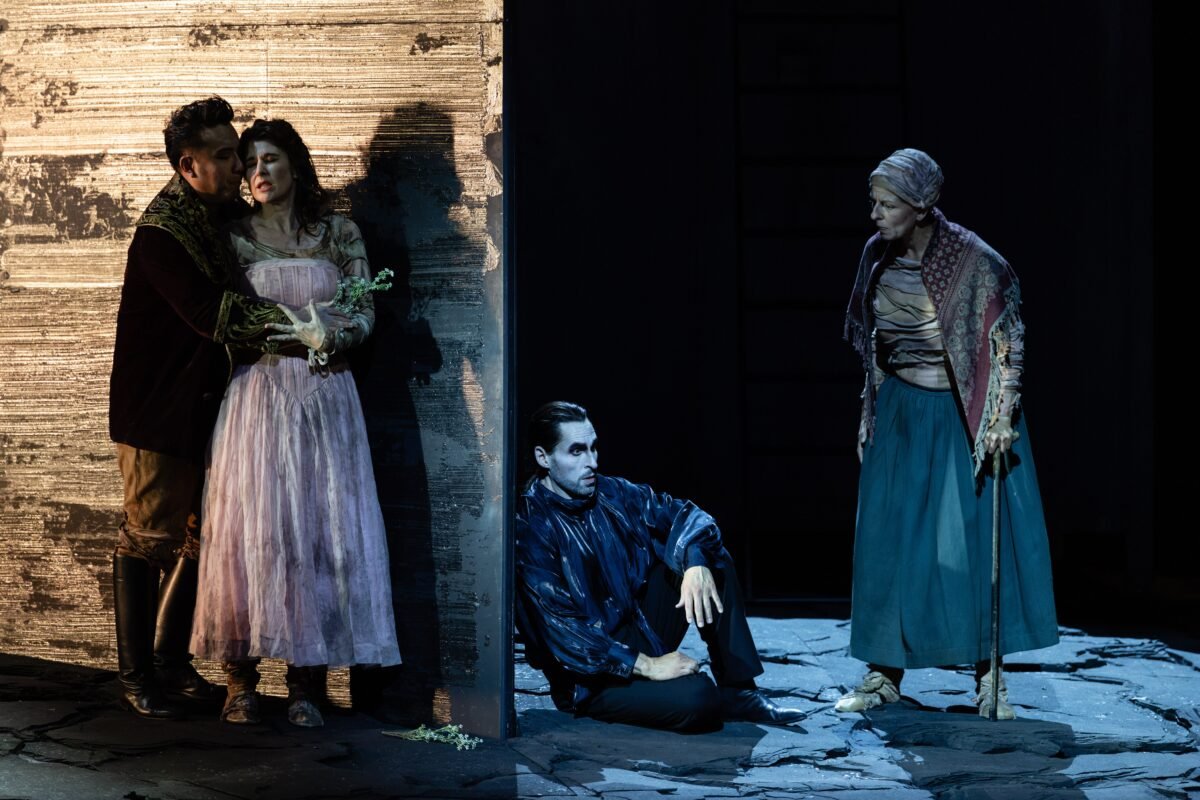
Photocredit: Geoffroy Schied
Gounod’s Faust at the Bayerische Staatsoper
(August 2026)
by Gianguido Mussomeli
“Rispetto alle prime recite, la parte musicale della rappresentazione era quasi completamente rinnovata. Per questa ripresa la direzione era affidata a Daniele Rustioni, giovane musicista milanese che in questi ultimi anni ha ricevuto lusinghieri apprezzamenti di pubblico e critica soprattutto per il suo lavoro come direttore stabile dell’Opéra national de Lyon.
Anche in questa occasione, come nelle altre in cui lo avevo ascoltato, Rustioni ha dimostrato piena comprensione della partitura oltre a un notevole senso del racconto teatrale, accompagnando il canto con flessibilità ed equilibrio e ottenendo belle sonorità dalla Bayerische Staatsorchester come sempre in ottime condizioni di forma. Le tinte orchestrali morbide e delicate nelle scene intime e la magnifica tensione drammatica ottenuta dalla bacchetta nella scena della chiesa e nell’ultimo atto erano i momenti migliori di una direzione davvero notevole per efficacia narrativa e carica teatrale.
Splendida era anche la prova del corodella Bayerische Staatsoper diretto da Christoph Heil, che nelle scene di massa del secondo e quarto atto si è imposto come vero coprotagonista della serata.”
by Montagu James
“Daniele Rustioni led the Bayerische Staatsorchester with confidence and energy. Never leaning into a sappy reading of Gounod’s score, Rustioni instead grounded the orchestra’s sound…the chorus of the Bayerische Staatsoper were in top form. Waving a white flag to surrender rather than triumph, the soldier’s chorus was a somber funeral procession for the wartime casualties, while in the final scene they collectively disassembled Marguerite’s prison bars announcing her salvation.
Although Faust opened the Met Opera’s inaugural 1883-84 season, it has somewhat receded in popularity in recent decades. …Yet the Faustian legend remains timeless. The strong cast, Rustioni’s no-nonsense reading, and De Beer’s stark unsentimental staging all made a case for Gounod’s continued place in the opera pantheon.”
by Jean-Nico Schambourg
“Das Hauptaugenmerkmal dieses Abends gilt aber der musikalischen Darbietung. Und hier werden die Hörerwünsche total erfüllt. Daniele Rustioni am Dirigentenpult leitet unaufgeregt das Bayerische Staatsorchester. Seine musikalische Vorstellung entspricht der Partitur von Gounod. Schon mit dem ersten Akkord erzeugt er die nötige Spannung, die er den ganzen Abend lang aufrechterhält. Je nach Situation erklingt es aus dem Graben geheimnisvoll, freudig jubelnd, zart, kraftvoll, romantisch, martialisch. Bei den Auftritten wirkt der Trommelwirbel wie das Feuern aus einer Maschinenpistole.
Ein weiteres Plus dieser Aufführung ist der Chor des Bayerischen Staatsoper, der wiedermal eine eindrucksvolle Leistung abliefert. Ob als Soldaten, feierndes Volk oder Mob der Marguerite das Leben zur Hölle macht, der Chor besticht stets durch seinen satten Klang.
…Diese exzellente musikalische Darbietung wird zum Schluss vom Publikum gebührend gefeiert.””
by Luis Gago
“Daniele Rustioni repetía asimismo como director y, con su creciente familiaridad con el repertorio francés gracias a su titularidad musical en la Ópera de Lyon, su Faust fue tan idiomático como el Freischütz del día anterior. Al italiano le sobran energía y capacidad para dobles cometidos tan dispares como estos y siempre sabe sacar el máximo rendimiento de la orquesta, al tiempo que no deja de estar pendiente un solo momento de los cantantes.”
by Guy Cherqui
“… For Rustioni, the stakes are high as he is set to conduct a new production of Faust at La Scala, it is therefore a way for him to rehearse the work with an orchestra he knows, and what's more, one of the best opera orchestras in the world. And this trial run, almost literally, is a masterstroke, so immense was the triumph won by the conductor and orchestra.
Immediately one feels Rustioni's grip on the orchestra and the commitment of the musicians who play with enthusiasm, producing a brilliant and particularly refined sound : one hears every level, every section, every line…The sound is clear, brilliant as noted… This music constantly demands subtlety, a crystalline rendering, a truly present sound that never abandons lightness. It is not about massive and impressive Grand-Opéra, but about seeking a transparency and flexibility that can be found in Halévy or even in serious Rossini. The whole difficulty comes from this weaving of influences, for which – a look at Offenbach would also not be unhelpful - Gounod has a strong sensibility, but also a true sense of scene and theatre ; he knows how to handle irony, and makes great use of instrumental timbres.
Similarly, the dark moments (the very beginning of the overture) must truly convey something infernal and fatal, with a very slow tempo, to then breathe with the melody (which is that of “avant de quitter ces lieux”). Gounod is never heavy, never massive ; he even has something of a Mozartean transparency at times (his Mephisto is Don Juan-esque...) : that's why, once again, never consider it a kind of big machine... Rustioni succeeded in transfiguring the third act, where the orchestra "accompanies" the action in the manner of a continuo, with discretion and constant presence.
The garden scene is one of the most successful moments of the evening.
…more at ease with the fourth and fifth acts, Rustioni is tenser, more restrained too, darker, more "felt," to deliver an anthology fifth act, a miracle of voice-pit balance and an immense musical moment. In short, Daniele Rustioni's conducting will undoubtedly require further deepening…The fact remains that overall, it is a direction that shows the conductor he is and the future he has. We can discuss this or that, we can quibble, but what a Faust it was.”
by Francis Muzzu
“…Musically, things were excellent. Daniele Rustioni conducted a broad and rich-toned reading of Gounod’s score and the orchestra played magnificently. Detail was all – I particularly relished the cello counter melody in Siebel’s Act IV Romance.
The chorus was outstanding – it was worth the price of entry just to hear their unaccompanied lines following Valentin’s death, truly perfect.”